
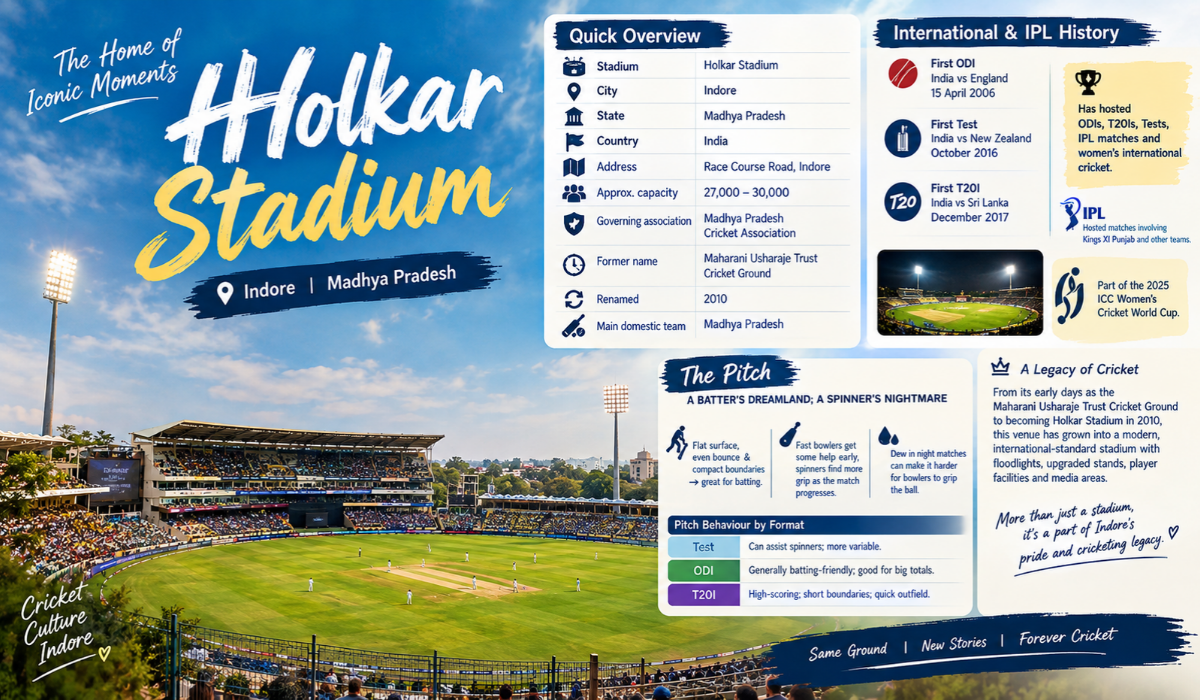
Holkar Stadium, located on Race Course Road in Indore, Madhya Pradesh, is one of India’s well-known international cricket venues. The stadium is operated by the Madhya Pradesh Cricket Association (MPCA) and has an approximate seating capacity of 27,000, although several cricket references list the capacity at around 30,000. It was originally known as Maharani Usharaje Trust Cricket Ground and was renamed Holkar Stadium in 2010. The venue hosted its first international match on 15 April 2006, when India played England in an ODI. Since then, it has hosted ODI, T20I, Test, IPL and women’s international cricket.
Holkar Stadium is particularly famous for high-scoring limited-overs matches. Its relatively compact boundaries, generally even bounce and quick outfield have helped produce memorable batting performances, including Virender Sehwag’s 219 in the 2011 ODI against West Indies and Rohit Sharma’s 118 from 43 balls in the 2017 T20I against Sri Lanka. The ground also became a Test venue in 2016 and hosted five matches during the 2025 ICC Women’s Cricket World Cup.
Quick Overview
Holkar Stadium is situated in the heart of Indore and is one of the principal cricket grounds associated with Madhya Pradesh cricket. The venue has developed considerably since its early years, with floodlights, upgraded stands, player facilities, media areas and other match-day infrastructure added over time. MPCA lists the stadium at Race Course Road, Indore, and identifies it as the association’s operating base.
The stadium has hosted some of the biggest names and most memorable performances in Indian cricket. Its international history includes three Tests, multiple ODIs and T20Is, while its IPL history includes matches involving Kings XI Punjab and other teams. The venue also became an important location during the 2025 Women’s Cricket World Cup.
| Information | Details |
| Stadium | Holkar Stadium |
| City | Indore |
| State | Madhya Pradesh |
| Country | India |
| Address | Race Course Road, Indore |
| Approx. capacity | 27,000–30,000 |
| Governing association | Madhya Pradesh Cricket Association |
| Former name | Maharani Usharaje Trust Cricket Ground |
| Renamed | 2010 |
| First ODI | India vs England, 15 April 2006 |
| First Test | India vs New Zealand, October 2016 |
| First T20I | India vs Sri Lanka, December 2017 |
| Main domestic team | Madhya Pradesh |
Read Also: Rawalpindi Cricket Stadium || Dubai International Stadium
History and Background
The ground was developed as the Maharani Usharaje Trust Cricket Ground and gradually expanded into an international-standard venue. The development included work on the pitch block, stands, pavilion and other facilities. According to MPCA’s historical gallery, the stadium’s transformation continued through the 1990s and 2000s before it hosted its maiden ODI in April 2006.
The stadium received its present name in 2010 as a tribute to the Holkar dynasty, which had a long association with the development of cricket in Madhya Pradesh. Floodlights were installed as part of the venue’s modernization, allowing it to host day-night cricket. The first international match under lights at the ground was played in December 2011, a game remembered for Sehwag’s extraordinary double century.
Over the years, Holkar Stadium has hosted international cricket, domestic matches and IPL fixtures. Its first Test came in October 2016 when India played New Zealand. The venue later hosted the India-Bangladesh Test in 2019 and India-Australia Test in 2023, adding another important chapter to its cricketing history.
The Pitch: A Batters’ Dreamland; a Spinner’s Nightmare
The Holkar Stadium pitch is generally regarded as batting-friendly in limited-overs cricket. A relatively flat surface, even bounce and compact boundaries allow batters to play attacking shots with confidence. The quick outfield can also turn well-timed strokes into boundaries, making the venue capable of producing large totals.
The conditions can change as a match progresses. Fast bowlers can get some assistance with disciplined bowling early in an innings, while spinners may find more grip when the surface slows down. In night matches, dew can make it harder for bowlers to grip the ball. The pitch therefore cannot be described in exactly the same way across every format, particularly because Test cricket can bring a greater role for spin.
Pitch Summary by Format
| Format | Typical pitch behaviour |
| Test | Can assist spin as the match develops |
| ODI | Generally good for stroke-making and high scores |
| T20I | Strong batting conditions with short boundaries |
| IPL | Historically produced several high-scoring games |
| Women’s ODI | Capable of supporting both large totals and strong bowling spells |
Important pitch characteristics include:
- Even bounce for stroke-making
- Relatively short boundaries
- Fast outfield
- Limited assistance for bowlers early in many limited-overs games
- Spin can become more relevant as the surface changes
- Dew may influence night matches
Records at Holkar Stadium: ODI Cricket
Holkar Stadium has produced some of the most memorable ODI performances in Indian cricket. The most famous came in December 2011 when Virender Sehwaq scored 219 against West Indies. India finished that match with 418/5, which remains one of the most notable ODI totals recorded at the venue.
The venue also witnessed India’s strong ODI performances for many years. However, New Zealand ended India’s unbeaten ODI record at the ground in January 2026 after scoring 337/8 and winning by 41 runs. Daryl Mitchell and Glenn Phillips made major contributions for New Zealand, while Virat Kohli scored 124 for India.
Key ODI Records
| ODI record | Performance |
| Highest team total | India 418/5 vs West Indies, 2011 |
| Highest individual score | Virender Sehwag 219 vs West Indies, 2011 |
| Best bowling figures | S. Sreesanth 6/55 vs England, 2006 |
| Notable successful chase | India 294/5 vs Australia, 2017 |
| Latest ODI at venue | India vs New Zealand, January 2026 |
The 418/5 remains one of the defining statistics associated with Holkar Stadium. Sehwag’s 219 was particularly significant because it was the highest individual ODI score at the time and became one of the landmark double-centuries in the format.
Records at Holkar Stadium: T20I Cricket
Holkar Stadium has also developed a reputation for exciting T20 cricket. One of its most famous T20I performances came in December 2017 when Rohit Sharma scored 118 from only 43 balls against Sri Lanka. He reached his century from 35 balls, matching the fastest T20I hundred at that time.
India scored 260/5 in that match, demonstrating how quickly runs can accumulate at the venue. The stadium has also hosted T20Is against Afghanistan and other opponents, giving the ground a strong association with high-scoring short-format cricket.
Key T20I Records
| T20I record | Performance |
| Highest team total | India 260/5 vs Sri Lanka |
| Highest individual score | Rohit Sharma 118 |
| Fastest century at venue | Rohit Sharma, 35 balls |
| Best bowling figure | Yuzvendra Chahal 4/52 |
| Highest successful chase | India 173/4 vs Afghanistan |
The T20I statistics show why Holkar Stadium is often discussed as a venue where aggressive batting can have a major impact. At the same time, bowlers need to use variations, accurate lengths and changes of pace because mistakes can quickly become boundaries.
Records at Holkar Stadium: Test Cricket
Holkar Stadium became India’s 22nd Test venue when it hosted India against New Zealand in October 2016. India made a huge 557/5 declared in the first innings, while Mayank Agarwal later recorded 243 during India’s Test history at the venue. The ground therefore has a strong record of producing substantial individual and team performances in the longer format.
The 2023 Test between India and Australia provided a different picture. Australia won by nine wickets after India were dismissed for 109 and 163, while Nathan Lyon claimed 8/64 in India’s first innings. The match demonstrated that the surface can also become challenging for batters when spin comes strongly into play.
Key Test Records
| Test record | Performance |
| Highest innings total | India 557/5 declared |
| Highest individual score | Mayank Agarwal 243 |
| Best bowling in an innings | Nathan Lyon 8/64 |
| Most wickets in a Test | Ravichandran Ashwin 13/140 |
| First Test | India vs New Zealand, 2016 |
| Most recent completed Test | India vs Australia, 2023 |
The Test record at Holkar Stadium is particularly interesting because it shows how conditions can vary by match. The venue can produce substantial batting totals, but spin has also played a major role in several Tests.
Holkar Stadium Women’s International Cricket
Holkar Stadium became one of the venues for the ICC Women’s Cricket World Cup 2025. The tournament schedule included several matches at Indore, bringing leading international women’s teams to the venue. Australia opened its campaign against New Zealand at Holkar Stadium on 1 October 2025.
The stadium hosted five matches during the tournament. Australia scored 326 against New Zealand in the opening match at the venue, while England later defeated India by four runs after England made 288/8 and India replied with 284/6. Australia also defeated England and South Africa at the venue during the tournament.
IPL at Holkar Stadium
Holkar Stadium has been used as an IPL venue since 2011. The ground became particularly associated with Kings XI Punjab, who used Indore as a second home venue during the 2017 and 2018 seasons. The stadium also hosted IPL matches involving other teams during those seasons.
The 2018 IPL season produced several notable totals at the venue. Kolkata Knight Riders scored 245/6 against Kings XI Punjab, while Royal Challengers Bengaluru chased 89 against Punjab after dismissing them for 88. IPL.com lists four matches at the stadium in the 2018 season, with an average first-innings score of 162.
Some notable IPL facts include:
- First IPL match at the stadium was played in 2011.
- Kings XI Punjab used the venue as a second home ground.
- The stadium hosted IPL matches in 2017 and 2018.
- KKR recorded 245/6 in 2018, one of the venue’s biggest IPL totals.
- RCB bowled Punjab out for 88 in the final IPL match listed at the venue in 2018.
Climate and Best Time to Trip
Indore has a typical central Indian climate, with hot summers, a monsoon season and comparatively pleasant winter months. For visitors planning a stadium tour or a cricket-related trip, the cooler period from around October to March is generally more comfortable than the peak summer months.
Cricket schedules can also influence the best time to visit. October and November can be particularly interesting because Indore often hosts cricket during the post-monsoon period, while winter provides more comfortable daytime and evening conditions for sightseeing. Before travelling for a match, visitors should check the official match schedule, ticket information and local weather forecast because conditions can vary from one day to another.
How to Get to Holkar Stadium
Holkar Stadium is located on Race Course Road in Indore and is relatively central within the city. The venue is accessible by road and can be reached using taxis, app-based cabs, auto-rickshaws and local transport services. Visitors arriving from outside Indore can first reach the city by train, bus or flight and then continue toward Race Course Road. The stadium is approximately in the New Palasia area, making it accessible from several major parts of Indore.
Ways to reach the stadium include:
- By taxi or cab: Convenient for visitors travelling directly to the stadium.
- By auto-rickshaw: Common for shorter city journeys.
- By local road transport: Useful for visitors already staying in central Indore.
- By train: Arrive at Indore railway station and continue by road.
- By air: Reach Devi Ahilya Bai Holkar International Airport and take a taxi or cab.
Location: Holkar Stadium
Holkar Stadium is located on Race Course Road in Indore, Madhya Pradesh. MPCA gives the stadium address as Holkar Stadium, Race Course Road, Indore 452003. The venue is situated in an established part of Indore, with roads and commercial areas around it. Its central location makes it relatively convenient for spectators staying in the city. Visitors should allow additional travel time on match days because traffic and security arrangements can affect access around the stadium.
Conclusion
Holkar Stadium is an important cricket venue with a history that covers international cricket, Test matches, T20Is, ODIs, IPL fixtures and women’s international cricket. From its early identity as Maharani Usharaje Trust Cricket Ground to its modern role as an international venue, the stadium has developed into an important part of Madhya Pradesh’s cricket infrastructure.
The venue is especially remembered for extraordinary batting performances such as Virender Sehwag’s 219 and Rohit Sharma’s 35-ball century. At the same time, its Test record shows that spin can become influential when conditions change. With its central Indore location, modern facilities and history of memorable matches, Holkar Stadium remains an important destination for cricket fans.
FAQs About Holkar Stadium
Q1. How many seating capacity of Holkar Stadium?
Holkar Stadium has an approximate seating capacity of around 27,000 according to the Madhya Pradesh Cricket Association. Other cricket references commonly list the capacity at around 30,000, so the figure can vary depending on how seating and temporary arrangements are counted.
Q2. Is Holkar Cricket Stadium batting-friendly?
Yes, Holkar Stadium is generally considered batting-friendly, particularly in limited-overs cricket. Its relatively short boundaries, even bounce and fast outfield have contributed to several high-scoring matches. However, spinners can become more effective as the surface changes, especially in longer formats.
Q3. Which IPL team uses Holkar Stadium as its home ground?
Kings XI Punjab used Holkar Stadium as a second home venue during the 2017 and 2018 IPL seasons. The team played several home fixtures at Indore during those campaigns.
Q4. Which international game was first played at Holkar Stadium?
The first international match at Holkar Stadium was an ODI between India and England on 15 April 2006. S. Sreesanth recorded figures of 6/55 in that match.
Q5. When to watch a cricket match at Holkar Stadium?
The best time to watch a match depends on the international or domestic schedule. For visitors concerned about weather, the cooler months from October to March are generally more comfortable than the peak summer period. Match-day schedules and ticket availability should always be checked before travelling.
Q6. When did Holkar Stadium host its first Test match?
Holkar Stadium played its first Test match in October 2016 when India played New Zealand. India won the match by 321 runs, making the occasion an important milestone in the stadium’s history.
Read Also: JLN Stadium || Chepauk Stadium || Barabati Stadium
